

Several years ago, custom homebuilder Shrock Construction mapped out plans for its most ambitious project: a new fully developed community of duplexes featuring more than 30 homes.
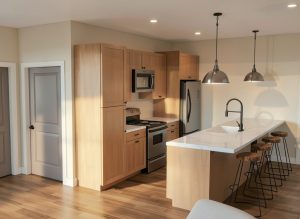
Designs of the kitchen of one of the duplexes designed by Shrock Construction. The builder collaborated with Noble REMC, which highlighted energy efficient appliances that can best support the new all-electric community’s residents.
The family-owned business hit roadblocks on possible gas utility service once planning began … until an electric co-op reached out to eagerly welcome the neighborhood to the neighborhood.
Noble REMC and Wabash Valley Power Alliance awarded Shrock Construction a $10,000 Site Readiness Grant for site preparation work as the company prepares its new complex in Ligonier, Indiana. Shrock Construction is building an all-electric residential community featuring 16 duplexes, or 32 housing units total, for homeowners aged 50 and older. The funding will help offset some initial costs, and Noble REMC has supported Shrock Construction to get connected with banks and other local businesses.
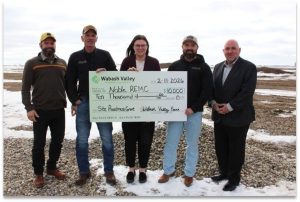
Noble REMC Energy Advisor Brian Hawk; Shrock Construction CEO Gable Shrock; Zyan Miller, economic development relations specialist for Wabash Valley Power Alliance; Shrock Construction Project Manager Austin Shrock; and Noble REMC CEO Brad McCrea highlight the award of WVPA’s Site Readiness Grant to the homebuilder. Wabash Valley Power and Noble REMC supported Shrock Construction to build its new all-electric retirement community on cooperative lines.
“It’s really big for us,” said Austin Shrock, project manager for Shrock Construction who has more than 20 years of homebuilding industry experience. “Being a smaller contractor, we don’t receive block grants or anything like that. It’s nice to have the support from Noble REMC and Wabash Valley.”
Shrock Construction has been creating custom homes for nearly 35 years. A few years ago, the family business planned to embark on the new community and found the 15-acre parcel on Noble REMC lines. As the Shrocks began talking with Noble REMC Energy Advisor Brian Hawk, they determined that the complex would feature all-electric duplexes.
Hawk highlighted the value of cold climate air source heat pumps, and how they can provide efficient heating down to -22 degrees Fahrenheit. They can handle northeast Indiana’s frigid winters, and qualifying models are eligible for Power Moves® energy efficiency rebates from the REMC and Wabash Valley Power.
“The Shrocks have been very good to deal with,” Hawk said of collaborating with Austin and his father, Gable, who owns the business. “They have been very excited to work with us.”
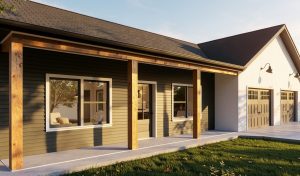
Design example for the exterior of the duplexes designed by Shrock Construction for the new neighborhood on Noble REMC lines. The cooperative worked closely with the custom home builder on incentives and planning for the new all-electric neighborhood.
The new community will provide much-needed housing supply. The residential shortage across the U.S. has worsened the housing affordability crisis; the shortage is particularly impactful in rural areas. While the new community will be for older residents, many will downsize or sell their homes, adding more inventory to the local housing market for people to move to the region.
“We’re right between Goshen and Fort Wayne, which are experiencing huge growth. But half hour away, where we are, there’s been much less,” Shrock said. “Even appraisals to get everything lined up for sales are tough because there has been so little development in the past decade.”
With the ground prepped, Shrock Construction is currently finishing the permitting process to begin construction. The first residents should begin moving in later this fall.
“Many rural communities lack the housing to attract and retain families and the workforce to fulfill local employers’ needs, and that can really impact the economy,” said Zyan Miller, economic development relations specialist at Wabash Valley Power who worked with Shrock Construction on the grant. “This new complex will provide much needed housing and showcases what can be done when local organizations partner together to foster community development.”