

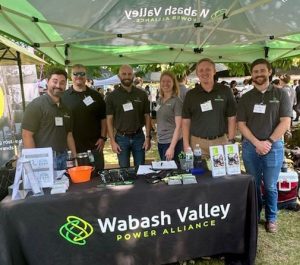
Melissa Oeters, center, joins our Wabash Valley Power recruiting team for a career fair at Purdue University.
As lead engineer of our transmission line development, Melissa Oeters experienced a fascinating pathway to serving electric cooperatives. She began her career as a civil engineer before moving to a path that’s led to the electric cooperative industry! Learn about Melissa’s experience on exploring interests and how that led to new opportunities to grow her career.
• Can you tell us a little about your role at WVPA and what drew you to this type of engineering work?
I am the lead transmission line engineer in WVPA’s engineering group. I work on the design of transmission lines from 34.5kV to 345kV, and I also support siting of new lines, material procurement, member coordination, and project construction. I enjoy working on projects that benefit the community and I love that I get to be involved in the full life cycle of transmission projects.
• What do you enjoy most about the work you do each day?
I enjoy interacting with project stakeholders. Working for a co-op gives me the opportunity to be hands-on with members of the community, which reminds me why our work is important.
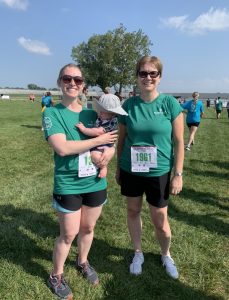
WVPA Lead Engineer – Transmission Line Melissa Oeters, left, posing with WVPA Chief Operating Officer Theresa Young at Corporate Challenge.
• What is something people might be surprised to learn about transmission line engineering?
Design engineering is only part of what I do! I also spend a lot of time working on project planning and line routing, consultant and contractor coordination, and construction support.
• When you were a student or early in your career, did you imagine yourself working in transmission engineering?
Transmission engineering wasn’t really on the radar for me. My degree is in civil engineering with a focus on construction, and I expected to follow a more common path into structural or transportation projects. I remember lines a mile long at the investor-owned utilities’ booths at career fairs, seemingly filled only with electrical engineers. I didn’t realize there was a place for civil engineers in transmission engineering until I was a few years into my career.
• What has your career path looked like, and what experiences helped shape where you are today?
I started my career in field engineering and construction of heavy civil/road and bridge projects. Over time, I became more interested in engineering design and found an opportunity to work on design in the transmission space. My first engineering design role was in transmission line engineering for an IOU where leadership strongly encouraged us to spend time on project sites and interact with construction teams while our designs were being built. It was a great way for me to transition from full-time work on construction sites to a more traditional design role.
• Can you share a project or moment in your career that stands out as especially memorable?
It’s great when projects go as planned, but the moments that stand out most to me are the ones where something changed. Maybe we learned something after we broke ground that prevented us from building as planned, or maybe a teammate or one of our members said “Okay, but you know what would make this better?” and we went back to the drawing board in a hurry.
Quickly coming up with a new solution is stressful, but in those moments, I get real-time feedback from member co-ops, WVPA teammates, and construction partners and use it come up with a solution that is immediately applied. It drives home the idea that by remaining engaged with projects throughout their life cycle, I can have a positive impact on the outcome.
• What has been one of the biggest challenges in your career, and what did you learn from it?
The transition from road and bridge construction into transmission line engineering has been my biggest challenge to date. I thought changing industries would be a setback to my career. I certainly had a lot of catching up to do, but I learned that my prior experience still had value, even when making a significant change. Having field experience has been a benefit in my design career – it helps me look at projects from a different perspective.
• What skills or qualities have been most important in helping you succeed in this field?
Having a consistent approach to problem-solving has been a helpful skill throughout my career.
• What advice would you give to students or early-career professionals who are still figuring out where they fit in engineering?
Explore your interests! Internships can be a great way to try out an industry while gaining valuable experience. Even if you’re already in the workforce, if an opportunity really jumps out to you, then go for it! Your experience to date probably translates better than you think.
• What makes WVPA a meaningful place to build a career, especially for someone just getting started?
There are so many ways to grow at WVPA. Professional development is just one part of it. This is a great place to be part of a collaborative, supportive team that proudly serves our members. Even from within one role, in one department, I can impact so much for our members and the communities we serve.