

Hannah would fascinatingly glance up at the power lines near her backyard and wonder how they worked. That curiosity lit up an engineering career that now involves keeping the lights on for towns and cities across the Midwest!
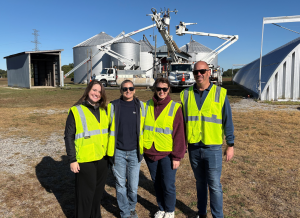
Hannah Hatchard, far left, as part of a group of Wabash employees visiting a member distribution co-op. Hatchard’s fascination with power lines led to her career in the electric cooperative industry.
Learn more about how Hannah started her engineering career, and what she enjoys about working with Wabash Valley Power.
• Tell us about your role at WVPA.
I am a transmission planning engineer. The best way I can describe my job is that I look at the power system from an electrical connection perspective and run simulations to essentially try to “break” it. By doing that, I can identify vulnerabilities in the system and then propose and test projects that will strengthen and improve system reliability.
• What does a typical workday look like for you?
Typically, I’m working in the office at my desk. I check on the studies I’m currently running, work on reports documenting my findings, and update scoping documents for projects we are planning to build. I also spend time several times a month traveling to our member offices, where I meet with their staff to discuss their plans, concerns, and ideas for their distribution systems.
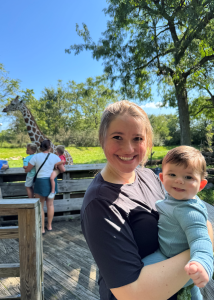
Hannah Hatchard with her son at the Indianapolis Zoo.
• What are some of the biggest challenges and rewards of working in transmission planning engineering?
One of the biggest challenges of transmission planning is that it can take a long time to see the impact of your work. I’m working with models that represent what the transmission system could look like two, five, or even ten years into the future, and I’m proposing and planning projects that may take years to go into service. You have to be patient, but when you eventually see a project get energized and know that you were the person helped plan it several years earlier, it’s really rewarding. It’s pretty cool to see something you worked on become a physical part of the system.
• What drew you to the power industry?
I was originally drawn to the power industry when I was young because we had power lines running behind our backyard, and I was fascinated by how they worked. I had no idea at the time that I would eventually build a career around them! Now that I’m in the power industry, I love having a job that has a direct, positive impact on people. Electricity isn’t a luxury in this day and age. It’s a necessity! I feel good knowing that the work I do helps keep the power system reliable and the lights on for my neighbors.
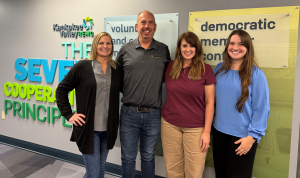
Hannah Hatchard, far right, as part of a group of Wabash employees visiting Kankakee Valley REMC.
• What skills are most important for success in your field?
I would say organization and problem-solving are two of the most important skills. Transmission planning involves a lot of compliance requirements, so you need to make sure your studies are well-documented, easy to understand, and repeatable. You also need to be a good problem-solver. Every study presents different challenges, whether that means finding and correcting a modeling error or determining which system upgrade will most effectively address an issue you’ve identified.
• What advice would you give students interested in engineering careers?
Keep your mind open and try lots of different things. Engineering is such a broad field, and there are so many different career paths within it. You never know what you’ll enjoy, or what you’ll be good at, if you never give it a try!
• What do you enjoy most about working at WVPA?
I love the culture at WVPA. We truly put our members first, and you can see that reflected in the way the company operates and makes decisions. It makes me feel good about the work I’m doing and the projects I’m contributing to, because I know they ultimately benefit the members and communities we serve.
• What has been your favorite career accomplishment so far?
My favorite career accomplishment has been creating and maintaining a new outage metrics system. The system identifies the areas experiencing the most frequent and longest outages, as well as the causes of those outages. I can then use that data to identify and develop projects that address one or even multiple issues at the same time. I really enjoy that this project takes data and turns it into something tangible that can improve system reliability.
• What do you find most rewarding about your work?
I love seeing the direct impact that my work has on people. A lot of what I do involves models, studies, and planning for the future, so it can sometimes feel removed from the people ultimately affected by it. Knowing that the work I do helps provide reliable electricity to homes, businesses, and communities makes it all worthwhile.
• What do you enjoy doing outside of work?
Right now, I spend most of my time with my family! My husband and I welcomed our first baby this year, a little boy. I love taking my son on walks with our dog, and we also frequent the Indianapolis Zoo.